In my day job, my team has started using a few old-school tools in our infrastructure architecture practice. One of these is
Quality Function Deployment (aka QFD, aka House of Quality) which has its roots in Six Sigma manufacturing quality practices.
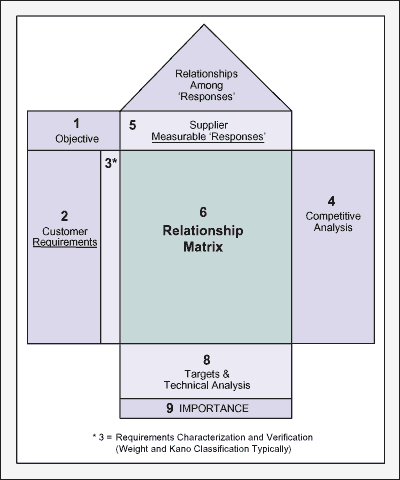 |
| QFD House of Quality graphic from iSixSigma.com |
While looking for a bit of information, I stumbled across an article titled “
Retiring the House of Quality.” Since we're just beginning to use QFD, I wanted to see what the problem was. Turns out the article wasn't critiquing QFD itself, but the (mis)use of QFD in “innovation processes.”
The article ties into many of the themes we’re investigating in my current
graduate school class on Evidence-Based Design (aka Human-Centered Design or
User-Centered Design).
I liked the distinction made between concept innovation and technical innovation; I found that quite useful.
 |
| Distinguishing initial concept innovation from downstream technical innovation - from Retiring the House of Quality |
But more importantly, I really appreciated the reframing around requirements where there were existing business processes with defined success metrics.
Consider the traditional approach of assuming that the technical solution team can identify certain technical requirements for the solution, and assuming that what is built meets those solution requirements are met, then the solution will address the business problem.
Instead of that approach, the authors suggest
having the existing business process success metrics directly become the solution requirements.
The outcome-driven innovation methodology uses customer-defined metrics (desired outcome statements) to guide the formulation, evaluation, and selection of new product and service concepts. The resulting concepts are tied directly to the customer’s desired outcomes—and the job the customer is trying to get done—increasing the likelihood that the customer will value the new concepts’ features. Because the inputs used to guide concept innovation are tied directly to the customer’s actual inputs, no translation is required.
Taking the business process requirements as the solution requirements rather than having to invent intermediate solution requirements is a great insight.
Literally, this is
disintermediation, but instead of disintermediating two parties by removing a middleman, it disintermediates a set of, well, intermediate requirements.
And because its exactly in that translation process of generating the intermediate requirements where technical solutions go wrong so often, it looks very promising for improving overall business satisfaction with solutions.












 Posts
Posts

