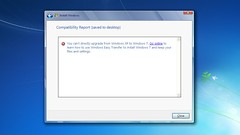
There's no in-place upgrade for XP to Win7. You'll need to use Windows Easy Transfer for your files & settings, and get ready to reinstall all your apps.
Now, you can still install Win7 on a PC running XP; it's just going to be a clean install of Windows into a new directory so you have a fresh user profile with nothing preserved in it.
You can jump through the WIndows Easy Transfer hoops to bring your files & settings back. But get ready to reinstall all your apps.
And if you have a netbook, check out the next picture in this set for a very unpleasant surprise!
Friday, May 01, 2009


Friday, April 10, 2009
If you love your users, set them free: Blogger import/export
This is one reason I'm really happy to keep using Blogger as my blog platform: I'm free to leave any time and take my content with me.
Blogger in Draft: import export: "This summer, we launched Import / Export on Blogger in Draft. The feature lets you export all of your posts and comments into a single, Atom-formatted XML file for easy backup. You can then import the posts back into Blogger, either into an existing blog or into a new one."
Moldova, Twitter and Nothing Under the Sun is New
First off, and most important: hooray for citizens of Moldova defending their democracy and freedom. In all sincerity - good luck with that, folks!
Lots of coverage right now about how Twitter was used to route around attempts at government censorship:
First, there's a new communications technology that's used where other established ones failed, in newsworthy circumstances. In this case, Moldovans used Twitter to spread news and organize protests, and that gets some things accomplished.
Second it gets noticed by people who are interested in the new communications technology, and they say "look what great stuff people are doing with this tech we are fans of! this reinforces our belief that the tech is great!"
But that's OK. Good stuff is good stuff.
If you like this stuff, this is a great piece to go further with these ideas:
Lots of coverage right now about how Twitter was used to route around attempts at government censorship:
Nation & World | Twitter heard as media ignore Moldova unrest | Seattle Times Newspaper: "Television stations around the world on Tuesday aired images of the violent protest, with the Parliament building and Voronin's offices on fire.So, there's two things going on here; nothing new under the sun.
But in Moldova, where press freedoms are weak, state television chose to broadcast a soap opera and another station showed images of dance routines.
So the pro-European protesters turned to Twitter and the Internet to keep in touch.
'We sent messages on Twitter, but didn't expect 15,000 people to join in. At the most we expected 1,000,'"
First, there's a new communications technology that's used where other established ones failed, in newsworthy circumstances. In this case, Moldovans used Twitter to spread news and organize protests, and that gets some things accomplished.
Second it gets noticed by people who are interested in the new communications technology, and they say "look what great stuff people are doing with this tech we are fans of! this reinforces our belief that the tech is great!"
But that's OK. Good stuff is good stuff.
If you like this stuff, this is a great piece to go further with these ideas:
Moldova's Twitter revolution is NOT a myth | Net Effect: "As someone who started the 'Moldova's Twitter revolution' meme, I think I owe the world another essay. No, no, I am not going to renounce the meme -- quite the opposite, I'd like to step up the debate."
Wednesday, March 25, 2009
John Carmack on iPhone development: Wolfenstein 3D Classic
I always enjoy reading a good Carmack tale of software development. One of these should go in Joel Spolsky's next Best Software Writing collections.
[NB: By the way I'm talking about the Carmack who is a videogame developer (You've heard of Doom? Quake?) not Carnac the Magnificent or Cormac the author. Cormac is, like Carnac, also magnificent, but not with a capital M.]
Here, John talks about bringing Wolfenstein 3D to iPhone.
Wolfenstein 3D Classic:
Perhaps the best quote of the article is the last line:
[NB: By the way I'm talking about the Carmack who is a videogame developer (You've heard of Doom? Quake?) not Carnac the Magnificent or Cormac the author. Cormac is, like Carnac, also magnificent, but not with a capital M.]
Here, John talks about bringing Wolfenstein 3D to iPhone.
Wolfenstein 3D Classic:
Rather than having a big confrontation over the issue, I told them to just send the project to me and I would do it myself. Cass Everitt had been doing some personal work on the iPhone, so he helped me get everything set up for local iPhone development here, which is a lot more tortuous than you would expect from an Apple product. As usual, my off the cuff estimate of "Two days!" was optimistic, but I did get it done in four, and the game is definitely more pleasant at 8x the frame rate.This next bit is a realization that more app designers need to have. It's all about what the user wants to do. Don't make me sit for your program to load. Fer cryin' out loud, Sidekick taught us this lesson! (No, THIS SideKick, not THAT Sidekick.)
And I had fun doing it.
....this was the first time I had taken full responsibility for an entire product in a very long time.
There is definitely something to be said for a game that loads in a few seconds, with automatic save of your position when you exit. I did a lot of testing by playing the game, exiting to take notes in the iPhone notepad, then restarting Wolf to resume playing. Not having to skip through animated logos at the start is nice. We got this pretty much by accident with the very small and simple nature of Wolf, but I think it is worth specifically optimizing for in future titles.Apple's interface guidelines do practically beg developers to take this perspective, not just as a feature to implement, but as a design philosophy.
Perhaps the best quote of the article is the last line:
...I do expect Classic Doom to come fairly soon for the iPhone.
Sunday, March 15, 2009
Gnothi Seauton
The Oracle said Know Thyself.
Polonius said basically the same thing.
I really appreciate this take on it from Roger Ailes:
And I see Poor Richard muses (no, not that Poor Richard)
Polonius said basically the same thing.
I really appreciate this take on it from Roger Ailes:
Another critical point: once you reach a comfortable, successful level of communications, you never have to change it, no matter what the situation or circumstances or the size of the audience. I define an audience as anyone other than yourself.Roger Ailes, in case that name is just vaguely ringing a bell, certainly has a track record of communicating effectively. These days he's blogging too, of course.
Whether there's one person or a thousand people listening to you, or if you're on television and there are millions watching [or if you're posting on the Internet and no one is watching - Dan] the essential principles hold true. The key element is that you not change or adapt your essential "self" to different audiences or different mediums. The thing that most confuses people trying to learn to be good communicators is the idea that somehow they have to act differently when giving an after-dinner speech than they would while being interviewed on television or for a job, or while conducting a staff meeting. They think they have to act all these different ways and nobody's given them the script to do this. Remember: You are the message, and once you can "play yourself" successfully, you'll never have to worry again.
And I see Poor Richard muses (no, not that Poor Richard)
No need to reach for the stars, either, because when you know and are true to yourself, the stars are inside you. Love to cook and invent your own recipes, like Silence? So you’re not the next Emeril or Rachael Ray. Maybe you’ll end up giving the occasional lecture on garden-fresh cooking, as Silence does, to small but enthusiastic audiences. Maybe you’ll end up publishing a cookbook. Maybe you’ll just continue to delight family and friends with your creations. Whatever the end result, it’s the joy of cooking and creating the dishes that’s the real deal. Anything else is extra.Bonus link: The Internet says The Oracle may have heard it (stolen it?) from Egyptians.
Monday, March 09, 2009
Maxim: The act of building forces one to clarify
From The Practice of Programming:
It's hard to design a program completely and then build it; constructing real programs involves iteration and experimentation. The act of building forces one to clarify decisions that had previously been glossed over....As much as possible, start with something simple and evolve it as experience dictates.
Sunday, March 08, 2009
I'd like to be in the beta of alpha
Now THIS is cool. It may not yet be flying cars and my own personal robot, but it's getting there - the future is getting closer every day.
Stephen Wolfram writes:
So naturally I've signed up for the beta of alpha.
Stephen Wolfram writes:
Some might say that Mathematica and A New Kind of Science are ambitious projects.
But in recent years I’ve been hard at work on a still more ambitious project—called Wolfram|Alpha.
And I’m excited to say that in just two months it’s going to be going live.
Mathematica has been a great success in very broadly handling all kinds of formal technical systems and knowledge.
But what about everything else? What about all other systematic knowledge? All the methods and models, and data, that exists?
Fifty years ago, when computers were young, people assumed that they’d quickly be able to handle all these kinds of things.
And that one would be able to ask a computer any factual question, and have it compute the answer.
But it didn’t work out that way. Computers have been able to do many remarkable and unexpected things. But not that.
I’d always thought, though, that eventually it should be possible. And a few years ago, I realized that I was finally in a position to try to do it.Excited? Me? Yes!
So naturally I've signed up for the beta of alpha.
It'll go live in May 2009 at http://www.wolframalpha.com/
Saturday, March 07, 2009
@kindlejunkie saved me via @twitter when @amazon's #Kindle #iPhone app didn't like me
Herein find the heartwarming tale of how the twitterverse saved me from the terrible fate of not being able to try out the Kindle iPhone app.
I cannot login - it says "no internet connection, please check your wifi or cellular data network and try again"
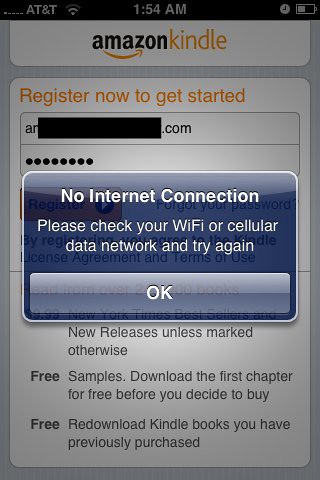
However I *do* have internet connectivity - and in fact if I change the PW to something wrong, the app correctly reports "Invalid email or password".
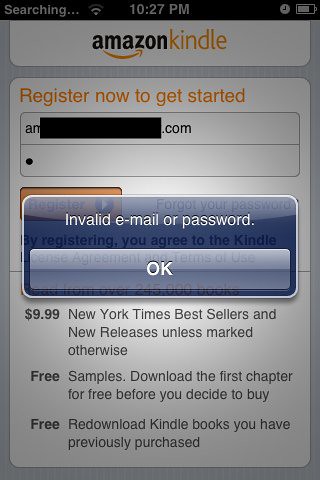
(I proved I had internet connectivity by uploading the screenshots on the spot with Pixelpipe app store link.)
What to do? Contacted amazon tech support with a detailed writeup & screenshots, but just got "can we talk to you live" and troubleshoot - great, not a known issue. I don't want to debug this, I want to play with it! :-(
But I was twittering about this, and out of the blue Julia Taylor aka @kindlejunkie started giving me suggestions:
Our account name is in the form of His & Hers Lastname. I changed the name on our amazon.com account by going to Your Account - Account settings - Change Name, E-mail Address, or Password. I changed it from "His & Hers" to "His and Hers" and:
Poof! Instant Kindle iPhone app success!
So, my very sincere thanks to Julia the @kindlejunkie!
Behold the awesome power of the twitterverse!
(And note this is another case study that the aforementioned powers work even for people who don't have thousands of followers....)
I cannot login - it says "no internet connection, please check your wifi or cellular data network and try again"
However I *do* have internet connectivity - and in fact if I change the PW to something wrong, the app correctly reports "Invalid email or password".
(I proved I had internet connectivity by uploading the screenshots on the spot with Pixelpipe app store link.)
What to do? Contacted amazon tech support with a detailed writeup & screenshots, but just got "can we talk to you live" and troubleshoot - great, not a known issue. I don't want to debug this, I want to play with it! :-(
But I was twittering about this, and out of the blue Julia Taylor aka @kindlejunkie started giving me suggestions:
@doofusdan Change your amazon.com p/w. Make the first character a lower-case letter. The rest can be upper/lower, special or numbers.Didn't do the trick though. I tried with another Amazon account (one I only use for things I'm going to expense for work, it doesn't get much use) but apparently Amazon decided that my iPhone was tied to the first Amazon account now. Drat. But @kindlejunkie was not giving up yet!
from Tweetie in reply to doofusdan
@doofusdan Read something somewhere about "&" in registered to name causing same error. Does that apply to you?
from Tweetie in reply to doofusdan
@kindlejunkie OMG! We DO have an & in our name! Holy cow is this just an escaped character bug? Those wacky amazon Perl hackers... :-)
from twhirl in reply to kindlejunkie
Our account name is in the form of His & Hers Lastname. I changed the name on our amazon.com account by going to Your Account - Account settings - Change Name, E-mail Address, or Password. I changed it from "His & Hers" to "His and Hers" and:
@kindlejunkie the & in our registered to name WAS the cause of the @amazon #kindle #iPhone app login fail! changing the"&"to "and" fixed it!
from twhirl in reply to kindlejunkie
Poof! Instant Kindle iPhone app success!
So, my very sincere thanks to Julia the @kindlejunkie!
Behold the awesome power of the twitterverse!
(And note this is another case study that the aforementioned powers work even for people who don't have thousands of followers....)
Saturday, February 28, 2009
I realize this post is not fully baked. I've got some obvious flaws in my reasoning. But my boys are home and I want to play with them, so I'm done thinking about this for now.
If only there was a place where people would come and, for absolutely free, point out every flaw in your reasoning.
Oh, wait - I know a place like that! Good. Here you go, you million-monkey-strong critics - tell me what I'm missing!
Microsoft is getting closer in parts of Windows 7.
But there are other parts of Windows that are hopelessly crufty in both underlying tech and in UX. Often times I suspect the crap UX is built right into the functional code, and fixing the former would require completely rewriting the latter because they're co-mingled code.
(I haven't examined the source, I could be totally full of crap. But fer cryin' out loud look at the name of this blog. Do you think I take myself all that seriously?)
Now Microsoft has been, for several years, realizing that they have to fix the architecture of their code in order to deal with their UX.
Simon Guest has been big in this.
But I also think of the UW CSE Colloquia talk I saw a few years back, where an analysis of Windows' codebase was done, and the resulting spaghetti pile of circular dependencies was finally seen for what it was: hopeless. This led to a renewed effort at making Windows more modular, which ended up headinng towards MinWin and Server Core.
The Exchange team deserves big credit here; Exchange 2007 was really much more cleanly modular with its implementation of server roles. But Exchange didn't just go modular; they also went with PowerShell - AFAIK, they were the first major production use for PowerShell, and they really proved the case in the real world by making life easier on Exchange admins and providing a more powerful set of tools - and enabling people to make their own tooling much better & more easily. (Yes, yes, I KNOW *nix admins have that that for ages. Quiet. That's not the point here.)
So the importance of PowerShell is that if you architect the code so it's cleanly modular, with a regular API for other parts of the system to interact with it, you can ALSO have the UX layer with flexibility to change - and either iteratively evolve towards improvements, or even try something completely different, WITHOUT FEAR of breaking the whole thing.
Having the capability doesn't mean success is inevitable. But it sure means success is more possible than it was before the capability was there.
If only there was a place where people would come and, for absolutely free, point out every flaw in your reasoning.
Oh, wait - I know a place like that! Good. Here you go, you million-monkey-strong critics - tell me what I'm missing!
Microsoft is getting closer in parts of Windows 7.
But there are other parts of Windows that are hopelessly crufty in both underlying tech and in UX. Often times I suspect the crap UX is built right into the functional code, and fixing the former would require completely rewriting the latter because they're co-mingled code.
Now Microsoft has been, for several years, realizing that they have to fix the architecture of their code in order to deal with their UX.
Simon Guest has been big in this.
But I also think of the UW CSE Colloquia talk I saw a few years back, where an analysis of Windows' codebase was done, and the resulting spaghetti pile of circular dependencies was finally seen for what it was: hopeless. This led to a renewed effort at making Windows more modular, which ended up headinng towards MinWin and Server Core.
The Exchange team deserves big credit here; Exchange 2007 was really much more cleanly modular with its implementation of server roles. But Exchange didn't just go modular; they also went with PowerShell - AFAIK, they were the first major production use for PowerShell, and they really proved the case in the real world by making life easier on Exchange admins and providing a more powerful set of tools - and enabling people to make their own tooling much better & more easily. (Yes, yes, I KNOW *nix admins have that that for ages. Quiet. That's not the point here.)
So the importance of PowerShell is that if you architect the code so it's cleanly modular, with a regular API for other parts of the system to interact with it, you can ALSO have the UX layer with flexibility to change - and either iteratively evolve towards improvements, or even try something completely different, WITHOUT FEAR of breaking the whole thing.
Having the capability doesn't mean success is inevitable. But it sure means success is more possible than it was before the capability was there.
I was thinking about the UX (user experience) of Kindle 2. I love the form factor and the idea of it. I love the payment model - buy the thing, and it just comes with an Internet connection, no monthly payment.
And it's so close to xkcd's insight.
But...
...I just couldn't use it for a net tablet. Because the UX isn't there.
A nettablet? Hmm, that'll get shortened to netablet. Are you net-able? net-table? Net table - that's Surface!
As I tweeted:
And it's so close to xkcd's insight.
But...
...I just couldn't use it for a net tablet. Because the UX isn't there.
As I tweeted:
The more I see of the Kindle2 the more I want a tablet iPhone. C'mon future, get here already!
And when I say "future" I mean "when someone can make one of these things that has as good UX as an Apple v1.0 product"
Subscribe to:
Posts (Atom)

 Posts
Posts

