Sunday, March 08, 2009

I'd like to be in the beta of alpha

Now THIS is cool. It may not yet be flying cars and my own personal robot, but it's getting there - the future is getting closer every day.

Stephen Wolfram writes:
Some might say that Mathematica and A New Kind of Science are ambitious projects.
But in recent years I’ve been hard at work on a still more ambitious project—called Wolfram|Alpha.
And I’m excited to say that in just two months it’s going to be going live.
Mathematica has been a great success in very broadly handling all kinds of formal technical systems and knowledge.
But what about everything else? What about all other systematic knowledge? All the methods and models, and data, that exists?
Fifty years ago, when computers were young, people assumed that they’d quickly be able to handle all these kinds of things.
And that one would be able to ask a computer any factual question, and have it compute the answer.
But it didn’t work out that way. Computers have been able to do many remarkable and unexpected things. But not that.
I’d always thought, though, that eventually it should be possible. And a few years ago, I realized that I was finally in a position to try to do it.
Excited? Me? Yes!

So naturally I've signed up for the beta of alpha.

It'll go live in May 2009 at http://www.wolframalpha.com/

Saturday, March 07, 2009

@kindlejunkie saved me via @twitter when @amazon's #Kindle #iPhone app didn't like me

Herein find the heartwarming tale of how the twitterverse saved me from the terrible fate of not being able to try out the Kindle iPhone app.

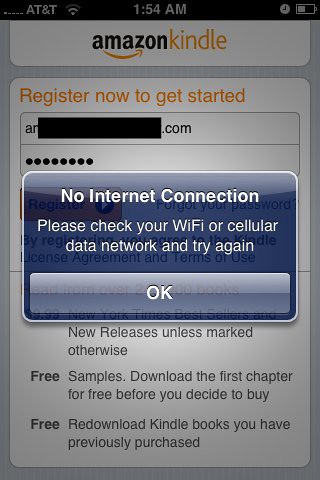
I cannot login - it says "no internet connection, please check your wifi or cellular data network and try again"

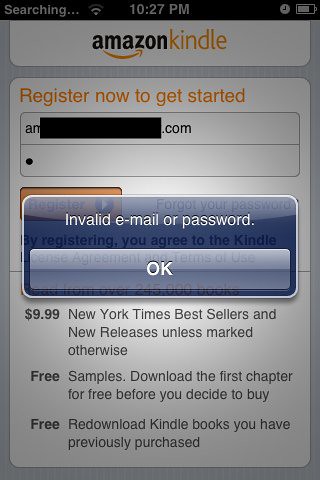
However I *do* have internet connectivity - and in fact if I change the PW to something wrong, the app correctly reports "Invalid email or password".

(I proved I had internet connectivity by uploading the screenshots on the spot with Pixelpipe app store link.)

What to do? Contacted amazon tech support with a detailed writeup & screenshots, but just got "can we talk to you live" and troubleshoot - great, not a known issue. I don't want to debug this, I want to play with it! :-(

But I was twittering about this, and out of the blue Julia Taylor aka @kindlejunkie started giving me suggestions:

@doofusdan Change your amazon.com p/w. Make the first character a lower-case letter. The rest can be upper/lower, special or numbers.
from Tweetie in reply to doofusdan


Didn't do the trick though. I tried with another Amazon account (one I only use for things I'm going to expense for work, it doesn't get much use) but apparently Amazon decided that my iPhone was tied to the first Amazon account now. Drat. But @kindlejunkie was not giving up yet!

@doofusdan Read something somewhere about "&" in registered to name causing same error. Does that apply to you?
from Tweetie in reply to doofusdan


@kindlejunkie OMG! We DO have an & in our name! Holy cow is this just an escaped character bug? Those wacky amazon Perl hackers... :-)
from twhirl in reply to kindlejunkie

Our account name is in the form of His & Hers Lastname. I changed the name on our amazon.com account by going to Your Account - Account settings - Change Name, E-mail Address, or Password. I changed it from "His & Hers" to "His and Hers" and:

@kindlejunkie the & in our registered to name WAS the cause of the @amazon #kindle #iPhone app login fail! changing the"&"to "and" fixed it!
from twhirl in reply to kindlejunkie

Poof! Instant Kindle iPhone app success!

So, my very sincere thanks to Julia the @kindlejunkie!

Behold the awesome power of the twitterverse!

(And note this is another case study that the aforementioned powers work even for people who don't have thousands of followers....)

Saturday, February 28, 2009

I realize this post is not fully baked. I've got some obvious flaws in my reasoning. But my boys are home and I want to play with them, so I'm done thinking about this for now.

If only there was a place where people would come and, for absolutely free, point out every flaw in your reasoning.

Oh, wait - I know a place like that! Good. Here you go, you million-monkey-strong critics - tell me what I'm missing!

Microsoft is getting closer in parts of Windows 7.
But there are other parts of Windows that are hopelessly crufty in both underlying tech and in UX. Often times I suspect the crap UX is built right into the functional code, and fixing the former would require completely rewriting the latter because they're co-mingled code.
(I haven't examined the source, I could be totally full of crap. But fer cryin' out loud look at the name of this blog. Do you think I take myself all that seriously?)
Now Microsoft has been, for several years, realizing that they have to fix the architecture of their code in order to deal with their UX.
Simon Guest has been big in this.
But I also think of the UW CSE Colloquia talk I saw a few years back, where an analysis of Windows' codebase was done, and the resulting spaghetti pile of circular dependencies was finally seen for what it was: hopeless. This led to a renewed effort at making Windows more modular, which ended up headinng towards MinWin and Server Core.
The Exchange team deserves big credit here; Exchange 2007 was really much more cleanly modular with its implementation of server roles. But Exchange didn't just go modular; they also went with PowerShell - AFAIK, they were the first major production use for PowerShell, and they really proved the case in the real world by making life easier on Exchange admins and providing a more powerful set of tools - and enabling people to make their own tooling much better & more easily. (Yes, yes, I KNOW *nix admins have that that for ages. Quiet. That's not the point here.)
So the importance of PowerShell is that if you architect the code so it's cleanly modular, with a regular API for other parts of the system to interact with it, you can ALSO have the UX layer with flexibility to change - and either iteratively evolve towards improvements, or even try something completely different, WITHOUT FEAR of breaking the whole thing.
Having the capability doesn't mean success is inevitable. But it sure means success is more possible than it was before the capability was there.
I was thinking about the UX (user experience) of Kindle 2. I love the form factor and the idea of it. I love the payment model - buy the thing, and it just comes with an Internet connection, no monthly payment.
And it's so close to xkcd's insight.
But...
...I just couldn't use it for a net tablet. Because the UX isn't there.
A nettablet? Hmm, that'll get shortened to netablet. Are you net-able? net-table? Net table - that's Surface!
As I tweeted:
The more I see of the Kindle2 the more I want a tablet iPhone. C'mon future, get here already!
And when I say "future" I mean "when someone can make one of these things that has as good UX as an Apple v1.0 product"

Maxims: YAGNI: You Ain't Gonna Need It

It's true. You really ain't gonna need it. 
In software engineering, YAGNI, short for 'You Ain't Gonna Need It', suggests to programmers that they should not add functionality until it is necessary. Ron Jeffries writes, "Always implement things when you actually need them, never when you just foresee that you need them." According to those who advocate the YAGNI approach, the temptation to write code that is not necessary at the moment, but might be in the future, has the following disadvantages:
  • The time spent is taken from adding, testing or improving necessary functionality.
  • The new features must be debugged, documented, and supported.
  • Any new feature imposes constraints on what can be done in the future, so an unnecessary feature now may prevent implementing a necessary feature later.
  • Until the feature is actually needed, it is difficult to fully define what it should do and to test it. If the new feature is not properly defined and tested, it may not work right, even if it eventually is needed.
  • It leads to code bloat; the software becomes larger and more complicated.
  • Unless there are specifications and some kind of revision control, the feature may not be known to programmers who could make use of it.
  • Adding the new feature may suggest other new features. If these new features are implemented as well, this may result in a snowball effect towards creeping featurism.
And if it turns out you do need it after all, don't worry. You'll have plenty of time to do it since you saved so much time not doing that other stuff that isn't needed.

Calling Yagni on that stuff works much better than calling shenanigans!

Friday, February 27, 2009

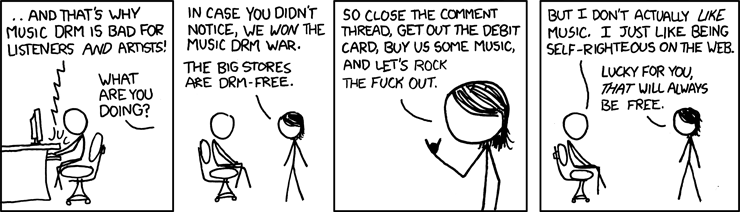
xkcd: we won the DRM war

xkcd is right - we won the DRM war. And yet some people just won't be satisfied.

Wednesday, February 25, 2009

The Netbook Effect: How Cheap Little Laptops Hit the Big Time

I am SO looking forward to getting my plate clear enough to start bringing these in.

The Netbook Effect: How Cheap Little Laptops Hit the Big Time:
"All of which is, when you think about it, incredibly weird. Netbooks violate all the laws of the computer hardware business. Traditionally, development trickles down from the high end to the mass market. PC makers target early adopters with new, ultrapowerful features. Years later, those innovations spread to lower-end models.

But Jepsen's design trickled up. In the process of creating a laptop to satisfy the needs of poor people, she revealed something about traditional PC users. They didn't want more out of a laptop—they wanted less."

Tuesday, February 24, 2009

Maxims: 97 things every software architect should know

Other people's maxims! Or, as they call them, axioms. (They're synonyms.)
The following are the 97 axioms selected for the book, 97 Things Every Software Architect Should Know, which will be published by O'Reilly Media in early 2009. The contents are now being edited for publishing - you can see them here. All edits will be contributed back to the 97 Things web site on this page.
Here are a few random selections to tease you. I have't read all 97 of these yet - in fact i haven't even read all of these links yet - but the maxims themselves are enough for me to repost 'em. And I saw plenty more I like where these came from.

2. Simplify essential complexity; diminish accidental complexity by Neal Ford
3. Chances are your biggest problem isn't technical by Mark Ramm
4. Seek the value in requested capabilities by Einar Landre
9. You're negotiating more often than you think by Michael Nygard
10. Quantify by Keith Braithwaite
18. Simplicity before generality, use before reuse by Kevlin Henney
19. Architects must be hands on by John Davies

So - have YOU got more maxims, axioms, or pointers to other people's deeptechthoughts? Do share! I love this collected & shared wisdom idea. Might just be the basis of civilization....

Saturday, February 21, 2009

Maxim: The stuff you want to store will expand; size disks accordingly

The stuff you have to store will always expand to fill your available storage. You won't go wrong buying as much disk space in your computer as you can afford. There's ALWAYS going to be something more you'll want to have space for.

Related to Max Out Your RAM - eventaully, if the device is upgradeable/expandable, then you may want to consider an upgrade a year or so after purchase to maximize cost/benefit. But if it's sealed (I'm looking at you, iPhone/iPod!) then max out the storage from the get-go.

This posting was inspired by the tragic tale of Duane, who just realized he should've gotten a 64gb SSD in his netbook instead of the 32gb.

This is also related to Keep Your Original Source Files in the Highest Resolution Possible.

Tuesday, February 17, 2009

The Great Reset

Behavior Gap says in The Great Reset:

"A recent New York Times headline read:

“Consumers Increase Savings While Spending Less”

That sounds like a GOOD thing doesn’t it?

It used to be that savings and thrift were basic, core, American values. Check out Tom Brokaw’s the Greatest Generation if you can’t remember a time when Americans valued thrift and savings. The media is so focused on “reviving” the economy that it is now seen as a negative sign when saving increases and spending declines. I know the economy as we have known it over the last 10-20 years depended on consumer spending, but the problem was THAT WAS MONEY WE DID NOT HAVE!"

There's a few more paragraphs, I recommend reading it.

Via Seattle Bubble who further comment:
Over the last few decades, we have constructed a sham economy that was not sustainable.

When the pyramid scheme failed (as all such schemes are destined to do eventually), rather than the healthy response of “whoops that was stupid, now let’s rebuild a sustainable, sound economy,” we’re hearing nonsense like “we need to prop up housing prices” and “we need to spur more consumer spending.”

Let’s put a stop to the delusion that things can just magically go back to the way they were when everybody (individuals and corporations alike) was hopped up on leverage. It’s not going to happen, nor should it.

Falling home prices and consumer spending are the necessary medicine that must be taken to return to a fundamentally sound and sustainable economy.